Hugging Face Launches Open TTS Leaderboard
- •Hugging Face launched an objective text-to-speech leaderboard as its Hub listed more than 8K TTS models.
- •Evaluation time drops from a couple weeks of vote collection to a couple hours using objective metrics.
- •Leaderboard covers multilingual performance, voice cloning, speed and speaker similarity while retaining listener voting.
Hugging Face introduced the Open TTS Leaderboard on September 30, 2026, to compare text-to-speech models using objective measures of intelligibility, speed and speaker similarity. The launch addresses a fragmented evaluation landscape: the Hugging Face Hub had more than 8K TTS models, while gathering enough human votes for arena rankings can take a couple weeks. With the new metrics, evaluating a model takes a couple hours.
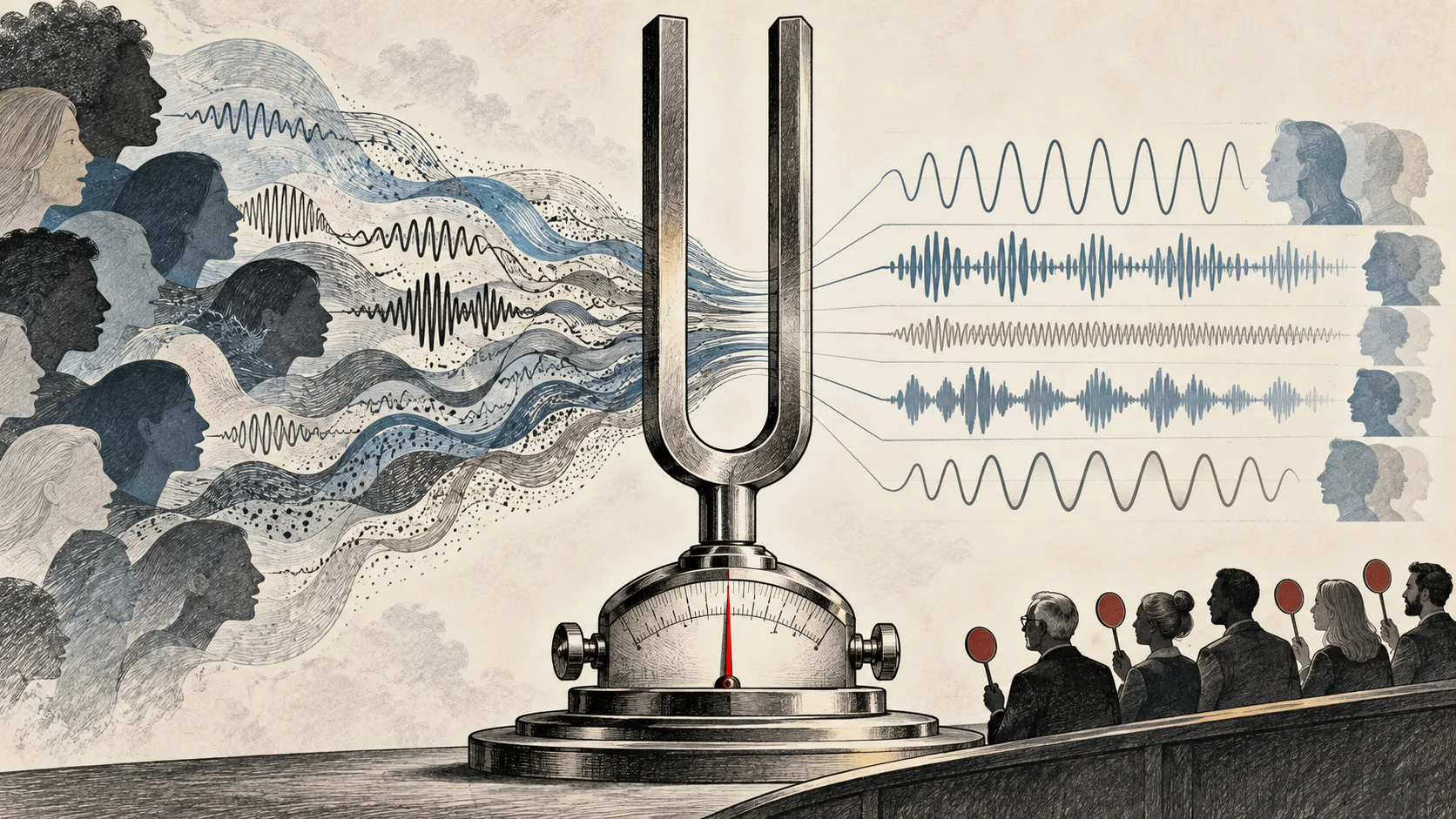
The leaderboard reports word error rate (WER) and character error rate (CER) using transcripts from Qwen3 ASR to estimate intelligibility. It measures offline batch speed with inverse real-time factor (RTFx) on an H200 GPU, streaming latency with time-to-first-audio (TTFA) on an H200 GPU and CPU, and speaker similarity with cosine similarity (SIM) between WavLM speaker embeddings from generated audio and a reference clip. Human preference remains the ultimate measure: these metrics do not directly assess naturalness, expressiveness or what listeners prefer.
In the English default view, models are ranked by macro-average WER across English splits of Seed TTS Eval and zero-shot CV3 Eval. hexgrad/Kokoro-82M, Supertone/supertonic-3 and fishaudio/s2-pro lead on that measure. Users can switch languages; Seed TTS Eval includes English and Chinese audio, so other language results use CV3 Eval alone. Chinese, Japanese and Korean use CER, and the “Average WER” across languages is a macro-average. k2-fsa/OmniVoice, fishaudio/s2-pro and FunAudioLLM/Fun-CosyVoice3-0.5B-2512 are strong multilingual models. A voice-cloning view compares supported models and adds SIM results; bosonai/higgs-tts-3-4b and openbmb/VoxCPM2 improve their average WER when given reference audio.
The Listen tab lets users compare generated audio by language and dataset, choose voice cloning, select models or hear a random selection, then vote and leave feedback. Users are asked to log in with a Hugging Face account to help remove spam and bots; community votes may be added to the leaderboard. The Streaming tab ranks models by TTFA. Each model processes one of the same 50 English CV3-Eval prompts at a time, on identical hardware and in its default voice. The first 3 runs are discarded as warm-up, and the reported TTFA is the median of the remaining runs. For streaming models, TTFA ends when the first audio chunk arrives; for non-streaming models, it ends when the whole utterance is generated. kyutai/pocket-tts performs well for streaming on both GPU and CPU.
The project currently focuses on open-source models and multilingual evaluation, with the stated aim of including models often absent from arena rankings and avoiding English performance as a proxy for other languages. The team says it will soon open-source the evaluation scripts and invites feedback on datasets, models and metrics through GitHub Issues and pull requests.
The fastest, most reliable AI news, straight to your inbox